Introduction
In the fall of 1981, the microcomputer landscape was a frontier of rapid innovation and burgeoning enthusiasm. Long before the advent of the commercial internet, the primary conduits for knowledge, software, and community were local user groups. These organizations served as indispensable hubs where hobbyists and early professionals gathered to exchange technical support, distribute public domain and member-created software, and collectively navigate the complexities of a new technological era. This document provides a detailed analysis of one such organization, the Toronto PET Users Group (TPUG), through the lens of its October 1981 bulletin, The TORPET (Issue No. 7). Based exclusively on the contents of this publication, this analysis offers a snapshot of TPUG’s organizational structure, its members’ technological ecosystem, and the intellectual culture that defined this vibrant microcomputer community.
1. Organizational Structure and Community Activities
The success and longevity of any user group depend heavily on its organizational framework and the value it provides through community events. These elements define the group’s identity, facilitate the crucial exchange of knowledge, and offer tangible benefits that attract and retain members. The structure of TPUG, as detailed in The TORPET, reveals a well-organized and highly active community dedicated to supporting its members.
1.1. Executive Leadership and Administration
The group was managed by a dedicated executive staff responsible for administrative, editorial, and community-facing roles. The public listing of their names and phone numbers underscores the accessible, peer-to-peer nature of the organization.
| Role | Personnel and Contact |
| President | Michael Bonnycastle, (416) 654-2381 |
| Vice. Pres. | Steve Punter, (416) 624-5431 |
| Secretary | Chris Bennett, (416) 782-9252 |
| Treasurer | Sandy Caven, (416) 962-0744 |
| Editor | Bruce Beach, (519) 925-6035 |
| Asst. Editor | Barb Bennett, (416) 782-9252 |
| Communications | Gord Campbell, (416) 492-2381 |
| Librarian | David Hook, (705) 726-8126 |
| Education | Don Whitewood, (416) 656-5140 |
| Westside Co-ord. | Jim Hindsman, (416) 335-5104 |
| At Large | Allen Farquharson, (519) 756-0489 |
Chris Bennett served as the central point of contact for the group’s administrative functions. The bulletin directs all correspondence concerning membership dues, advertising, requests for submissions, and subscriptions to The TORPET to him, highlighting his critical role in the day-to-day operations and content gathering for the group.
 1.2. Member Engagement and Scheduled Events
TPUG maintained a busy calendar of meetings and special events designed to cater to a range of member interests, from general networking to deep technical dives. These scheduled activities reveal a clear priority placed on collaborative learning and, most critically, the physical act of software sharing.
- Chapter Meetings: The group was large enough to support multiple chapters. The bulletin announced the upcoming Westside Chapter meeting for November 18th at Sheridan College and noted the next regular meeting of the Central Chapter was scheduled for Wednesday, December 9th.
- Special Interest Groups: For members with more advanced interests, a Machine Language (M.L.) group met under the guidance of Jim Carswell. Meetings were scheduled for the second Friday of the month at George Brown College, providing a dedicated forum for low-level programming enthusiasts.
- Super Copy Session: A special event scheduled for November 4th at Leaside was entirely dedicated to copying programs from the club library. This “Super Copy Session” was a logistical necessity in a pre-internet world, with the bulletin noting that “25 or 30 systems with disk drives” would be available. The instructions for members were simple and direct: bring your own blank disks or tapes.
1.3. Membership Services: The Software Library
The software library was arguably the most valuable tangible benefit of TPUG membership, acting as a repository of community knowledge and a distribution center for essential tools and entertainment.
- Size and Scope: The library was extensive for its time, containing “over 400 programs” covering business, education, utilities, and games.
- Access Policy: Access was a privilege of membership. The policy stated that the library was available to members ONLY. Full, dues-paying members had free access, while associate members could gain admittance to events by paying a $10 entry fee.
- Distribution Method: Programs were distributed physically. Members could bring their own media to events like the Super Copy Session to copy any programs they desired from the club’s collection.
This robust organizational structure and active event schedule provided the foundation for the group’s primary purpose: exploring and mastering the software and hardware of the Commodore PET.
2. The Technological Landscape: Software
The software discussed, reviewed, and distributed within The TORPET serves as a direct reflection of the TPUG community’s technical capabilities and diverse interests. The bulletin showcases a rich ecosystem of programming tools, practical applications, and games, demonstrating a clear transition from simple hobbyist experimentation to more sophisticated and productive uses of the microcomputer.
2.1. Programming Languages and Development Tools
TPUG members had access to an impressive array of sophisticated programming tools, including advanced languages, assemblers, and machine language monitors. These tools empowered users to move beyond the limitations of standard BASIC and extend the functionality of their machines in fundamental ways.
| Tool/Language | Platform/Developer | Key Features and Purpose |
| POWER | Professional Software (for PET 2001, 3000, 4000, 8000 series) | A language derived from BASIC with 12 new commands, including DEL (delete line), RANGE (re-numbering), and TRC (trace execution). It also integrated eight new array variables from BASIC AID. |
| COMAL | COMAL Users Group (for 32K PET/CBM) | A language combining BASIC’s ease with PASCAL’s structure. A starter kit was available for $47.50, including an interpreter, compiler, and 90 sample programs. |
| MAE Assembler | N/A | A Macro Assembler Editor designed as a learning aid for Machine Language (M.L.) programming. It was also positioned as a learning tool for another assembler, MAID. |
| MICROMON & SUPERMON | N/A | Machine language monitors residing in memory (MICROMON at $1000-$1D43). Provided commands like FILL MEMORY, HUNT MEMORY, and DISASSEMBLER. SUPERMON was distinguished by also including simple assembler functions. |
| BASIC AID | N/A | A utility with commands to enhance BASIC programming, such as Auto (line numbering), Change (string replacement), and Number (renumbering). |
| PROMINICO SORT ROM | Prominico Ltd. | A 2K 2716 EPROM for CBM 4032/8032 that provided fast sorting for 13 array formats and a substring search command (POSN). |
2.2. Business, Utility, and Educational Software
The advertisements and reviews in The TORPET illustrate the growing use of the Commodore PET for practical, real-world tasks in business, education, and home management.
- Database Management: FLEX FILES, a disk database program costing $60.00 U.S., was available for general file maintenance and could handle up to 62 fields per record when used with an 8050 disk drive.
- Mailing List: TPUG Secretary Chris Bennett offered his own creation, BENNETT’S MAIL LIST, a CBM/PET disk-based program capable of storing up to 600 records, which sold for $100 for the disk version.
- Business Accounting: The Commodore-supported BPI General Accounting System offered modules for General Ledger, Accounts Receivable, Inventory, and Payroll. Another option was the GENERAL LEDGER package from C.M.S. Software, priced at $300.
- Educational Software: For learning purposes, PET TUTO LESSONS were available in three parts for $40 each or as a complete set with manuals for $99.95.
- Games: A wide variety of commercial games were available, including titles like ATLANTIC PATROL ($7), CHECKER KING ($20), HELLFIRE WARRIOR ($32), and TIME TREK ($15).
2.3. Analysis of the TPUG Software Library Holdings
The detailed listings of the TPUG library’s contents provide the clearest picture of the membership’s collective interests and programming activities. The collection was a mix of serious tools, practical applications, and entertainment, with a noticeable emphasis on empowering the user.
- Assemblers and Machine Language Tools: The prevalence of tools like
MICROMON,BAID(BASIC AID), and multiple components for theMAEMacro Assembler Editor indicates a strong and active interest in low-level programming and system customization. - Business and Utilities: Practical applications filled the library disks, with titles such as
APARTMENT.INCOME,HOME ACCOUNTS.SU, and variousMAIL.LISTprograms. This shows a significant portion of the membership was using their PETs for small business and home management tasks. - Education and Math/Science: Titles like
MATH.TUTOR,FOREIGN WORDS,BIORHYTHM, andQUADRATICdemonstrate the use of the computer as a tool for learning, analysis, and scientific calculation. - Games and Entertainment: The library contained a vast assortment of games, from text-based strategy (
ADVENTURE.GALAX,WIZARDS.CASTLE) to action and skill games (BLACK.JACK,BASKETBALL). Notably, the listings included member contributions, such asTOMBS B-BNNYCSTL, a program associated with TPUG President Michael Bonnycastle, underscoring the community’s role in content creation.
This diverse software ecosystem ran on an evolving set of hardware platforms, which were a constant subject of discussion, modification, and anticipation.
 3. The Technological Landscape: Hardware

In 1981, a microcomputer was rarely a complete, out-of-the-box solution. Expanding its capabilities through peripherals, upgrades, and modifications was a primary concern for every serious user. The TORPET showcases a vibrant marketplace of official Commodore products, third-party peripherals, and user-driven hacks, all designed to enhance and extend the core PET platform.
3.1. Core Computer Systems: Present and Future
The bulletin reflects a community deeply invested in the Commodore product line, keeping a close eye on both the established systems and the next generation of machines.
- PET/CBM Series: This was the established platform for the user group, with a clear focus on the business-oriented models like the 4032/4016 series, which featured a 12-inch CRT.
- VIC Personal Computer: This new, lower-cost model was heavily promoted at $299. It offered features like color graphics (“eight background and eight border colours”) and sound, and could plug into a standard TV. However, its 9-inch screen was seen as a potential limitation compared to the larger PET displays.
- SuperPET (9000 Series): This was the highly anticipated high-end machine. Its specifications generated significant excitement, particularly its innovative dual-processor (6502 and 6809) design. It was projected to ship with a powerful suite of bundled languages, including APL, PASCAL, and MICROFORTRAN, at a price of $1995 to $2295.
 3.2. Peripherals and Expansion Hardware

To make their computers truly productive, TPUG members had access to a growing market of hardware peripherals and expansion options. These products were essential for tasks like printing, data storage, and communication.
| Category | Product Examples | Noteworthy Details (including price) |
| Printers | Olivetti Model 121, ANACON 150, TALLY 8024, CBM 4022 | The Olivetti was a daisy wheel typewriter interfaced to the PET, offered at a special TPUG price of $2695, retail $2700, and a used model for $1800. The ANACON 150 ($1150) and CBM 4022 ($795) were more affordable matrix printers. |
| Interfaces | ADA 1600 (Parallel), ADA 1450 (Serial), SADI | A range of interfaces from Batteries Included were required to connect various printers and peripherals to the PET/CBM. |
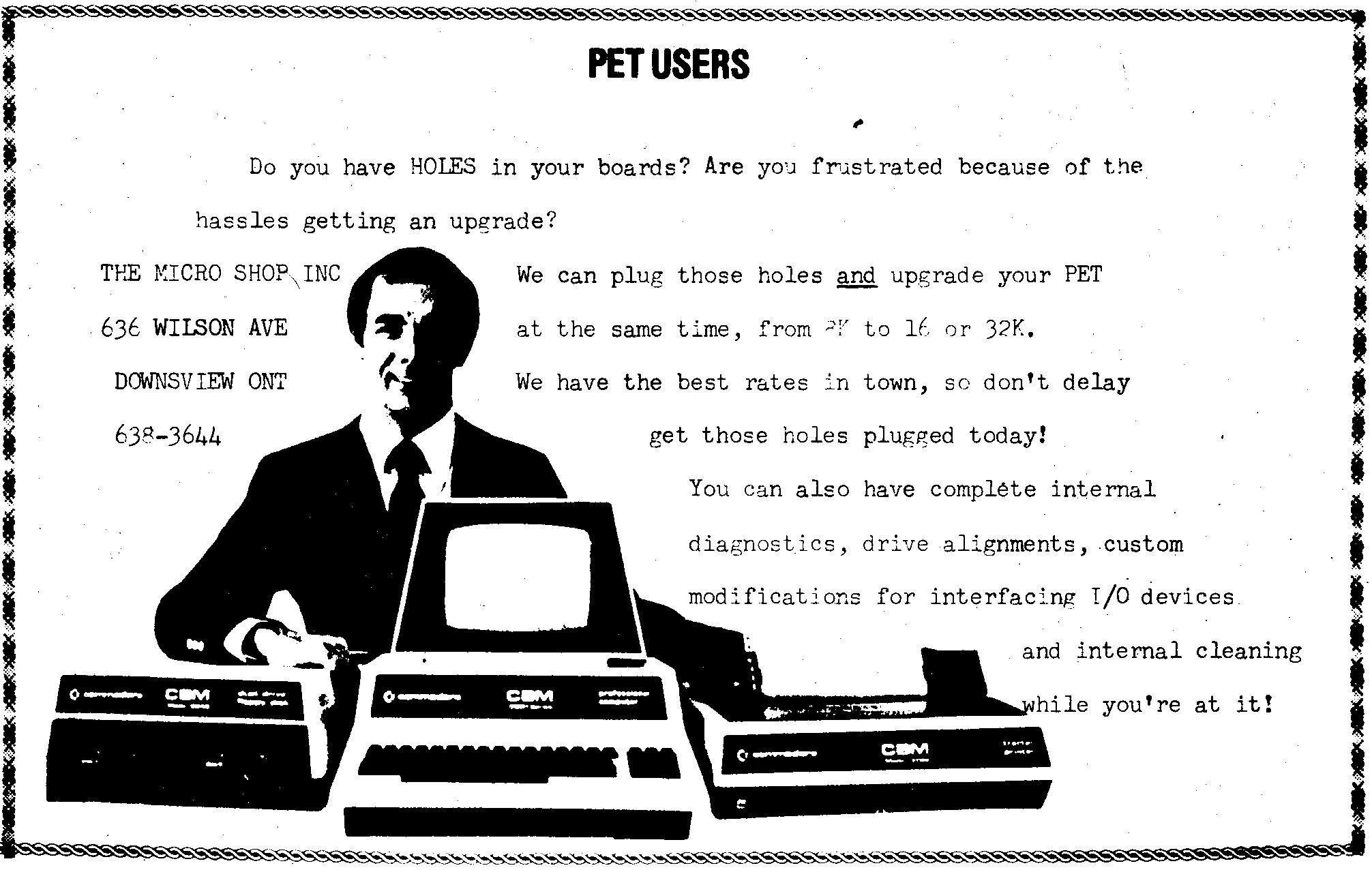
| Storage | MEMOREX 5 1/4″ Diskettes, C10/C20 Cassettes, Disk Drive Head Cleaning Kit | Memorex diskettes were advertised for their reinforced hub ring. Cassettes were $1.00 (C10) and $1.25 (C20). The cleaning kit ($39.95) highlights the hands-on maintenance required of users. |
| Communications | Modem 80 | A bulk purchase was being arranged for members at a rate of $20 per month. |
| ROM Enhancements | SOFFROM, QUADRA ROM | SOFFROM ($130) allowed toggling between 40 and 80 column displays. QUADRA ROM ($39.95) allowed four ROMs to occupy a single address. |
| Utility Hardware | DISK ERROR LIGHT, Light Pen | The DISK ERROR LIGHT ($30) was an add-on LED to confirm disk read/write operations. A Light Pen was available for $49.95. |

This price discrepancy for a single peripheral like the Olivetti highlights the emergence of a sophisticated secondary market for used hardware and demonstrates the tangible financial value of group membership discounts and access to a classifieds section.
3.3. User-Driven Hardware Modification
Beyond purchasing add-ons, the TPUG community demonstrated a sophisticated, hands-on approach to improving their machines. The article by Dieter Demmer detailing the procedure for converting a 4032/4016 PET from a 40-column to an 80-column display is a prime example of this ethos. The article provides detailed technical instructions on changing jumper settings on the main circuit board to enable the wider display format. This type of user-driven modification showcases the community’s technical self-sufficiency and its collective drive to overcome the perceived limitations of stock hardware, effectively creating more powerful systems through shared knowledge.
This deep engagement with the physical hardware was complemented by an equally intense intellectual engagement with programming philosophy and the broader computer industry.

4. Member Discourse and Industry Context
User group bulletins like The TORPET were more than just technical manuals or event calendars; they were forums for intellectual debate, industry commentary, and the formation of a shared technical culture. This issue reveals a community engaged in sophisticated discussions about programming philosophy and keenly aware of its relationship with Commodore and the wider market.
4.1. Contributions to Technical and Programming Philosophy
Articles contributed by members provided a platform for sharing best practices and debating the future of software development. These columns reveal a developing technical culture focused on efficiency, elegance, and pushing the boundaries of available tools.
- Jim Butterfield (“The Lazy Programmer”): In his column, Butterfield advocates for a form of “constructive laziness.” He argues that using programming structures like
FOR/NEXTloops instead of repetitive code is not just easier but leads to more flexible, reusable, and ultimately more powerful and elegant programs. - Henry Troup (“A Call for a Smarter Assembler”): Troup’s article calls for more advanced features in assemblers. He proposes new pseudo-ops, such as
CREATE UNALLOCATEDandCREATE ALLOCATE, to allow for more sophisticated and less error-prone management of variables and memory in machine language programming. - Chris Bennett (“The Basic Box”): This regular column functioned as a crucial knowledge-sharing hub. Bennett answered common questions about Commodore BASIC, providing direct support to fellow members while also offering product reviews, such as his analysis of the
PROMINICO SORT ROM.
4.2. Commentary on the Commodore Industry
Through sections like “Hotline” and the “Midnight Software Gazette,” the bulletin provided members with news, rumors, and sharp-eyed commentary on Commodore’s business strategies and products. This discourse illustrates the community’s perspective as both loyal customers and critical observers.
- Commodore’s Strategy: A significant piece of news was the report that Commodore had created a new department specifically to compete with third-party software vendors. This raised concerns within the community about the potential for future hardware changes that could restrict compatibility.
- Hardware Critiques: Members were not shy about voicing their critiques. The bulletin includes commentary on the need for Commodore to improve the operational speed of the 8050 disk drive and reports of “buggy” 2K ROMs at memory location $E800 that required a revision.
- Employment Opportunities: The growing professional relevance of PET expertise was highlighted by an advertisement offering a $100 reward for leads on hiring PET programmers. This indicates a clear demand for these skills in the commercial marketplace.
- Future Product Anticipation: The forthcoming SuperPET was a major point of interest and speculation. The community eagerly discussed its dual-processor architecture and advanced features, demonstrating a deep investment in the future of the Commodore platform.
These discussions reveal a community that was not just using technology, but actively shaping its own understanding of it and its place in the burgeoning industry.
 5. Conclusion

The October 1981 issue of The TORPET provides a remarkable window into the world of the Toronto PET Users Group, depicting a dynamic and sophisticated organization at the heart of the early microcomputer movement. TPUG was far more than a simple club; it was a vital ecosystem for technical education, a distribution network for a vast library of software, and a forum for peer support and intellectual exchange. This snapshot in time vividly illustrates the essential role that user groups played in fostering the technical skills, collaborative culture, and boundless enthusiasm that defined the first decade of the personal computing revolution. They were the crucibles where a generation of users became experts, transforming a niche hobby into a world-changing industry.
About The Author


